
Mark Jenkins
October 13, 2026
Review of Women Artists of the DMV: The Thank You Show
ON VIEW: 27 JUN – 18 OCT
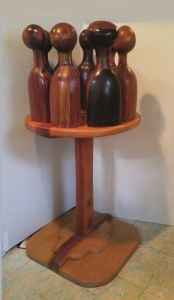
United We Stand, by Margery Goldberg
AN EPILOGUE TO THE “WOMEN ARTISTS OF THE DMV” project that began more than a year ago, “The Thank You Show” collects work by women who were especially helpful to curator and initiator Florencio Lennox (Lenny) Campello. Displayed in the smaller part of the Black Rock Center for the Art’s two galleries, the exhibition is not sweeping or definitive. But it’s a nice coda to the region-wide, 20-venue undertaking, and features one artwork that is, aptly, a different sort of appreciation: Prudence Bonds’s portrait of (and homage to) Alma Thomas, a pioneering local woman artist from an earlier generation.
The sculptural works include three intriguing examples of alternative monuments. Veronica Szalus’s towering ecological totem is constructed of such repurposed materials as wire mesh and painted paper tubes, while Margery Goldberg’s vision of cross-cultural affinity is a circle of eight stylized humanoids made of a “rainbow coalition” of different varieties of wood.
Sophia McCracklin offers a different sort of memorial, an oversized facsimile of a fern leaf rendered in wire-supported green Dacron.
Among the two-dimensional highlights are Helen Frederick’s pulp painting, a “Skyscape” featuring Rothko-like rough rectangles; one of Lisa Battle’s elegantly sinuous painted-ceramic forms; and a Michele Banks painting that can be read as a medical illustration or a graceful abstraction. Marcie Wolf-Hubbard’s earthy contribution is a charcoal drawing with literal depth, since its rendering of three mourning doves is upholstered with thick encaustic.
“Alma” aside, the show is short on images of women who meet the viewer’s gaze. Teresa Oaxaca’s vast painting depicts a woman who’s peering off to one side surrounded by babies, everyone in frilly garb and appearing vaguely alarmed. In Linda Button’s oil, three mannequins in a display window are partly obscured by reflections on the glass. In Oaxaca and Button’s pointed pictures, women are seen, but don’t look.
